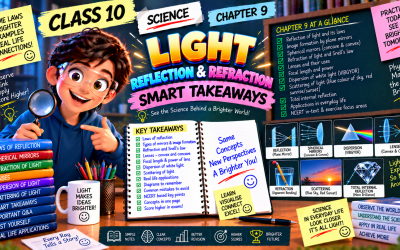


Class 10 | Science | Chapter 10 | The Human Eye and The Colourful World
Four Minutes of Stolen Time: The Secret Physics Behind Everything You See
Four Minutes of Stolen Time: The Secret Physics Behind Everything You See

The World You Never Truly See
We tend to think of our eyes as clear windows to the world, providing a raw, unfiltered feed of reality. But the truth is far more strange. Your eyes are not just windows; they are sophisticated, biological optical instruments, constantly refracting, filtering, and correcting a flood of data. What you perceive as a “beautiful sunset” or a “clear blue sky” is actually a complex series of physics puzzles happening inside your skull. To see is to participate in a grand, biological illusion where your brain and the atmosphere work together to curate the world around you.
Your Brain is Constantly Flipping the Script
Imagine a camera where the film is always loaded upside down. That is the fundamental reality of human sight. Light enters through the cornea—a transparent bulge on the front of your 2.3 cm-diameter eyeball—and is focused by a lens system onto a light-sensitive screen at the back of the eye. This screen is the retina.
Because of the way light refracts through a lens, the image projected onto your retina is actually real and inverted. You are, quite literally, seeing the world upside down.
“The retina is a delicate membrane having enormous number of light-sensitive cells.”
The moment these millions of cells are illuminated, they act as biological processors, converting light into electrical signals. These pulses race along the optic nerves to the brain, which performs a masterful “flip of the script,” processing the data so we perceive the world as right-side up.
The "Jelly" Lens and the 25cm Rule
Have you ever tried to read a text message by holding your phone two inches from your face? You immediately feel a sharp, pulling ache. This is the mechanical limit of your biology. Unlike the rigid glass lenses in a DSLR, your eye lens is a “fibrous, jelly-like” material controlled by ciliary muscles.
This system, known as the “Power of Accommodation,” allows us to change our focal length on the fly. When you look at the horizon, your ciliary muscles relax, making the lens thin. But when you look at something close, those muscles must contract, clamping down to increase the lens’s curvature and thickness. That “eye strain” you feel is the physical fatigue of those muscles working overtime. For a normal eye, the limit is the “near point” of 25 cm. Anything closer, and the muscles simply cannot contract enough to focus, leaving you with a blurred image and a biological headache.
Why the Sun "Cheats" the Clock by Four Minutes
Our atmosphere is a master of the “Time Heist.” Because the Earth’s air has a varying refractive index, it actually bends sunlight around the curve of the planet. This creates a persistent optical illusion: “advance sunrise” and “delayed sunset.”
We see the Sun approximately two minutes before it actually crosses the horizon in the morning, and we keep seeing it for two minutes after it has physically vanished in the evening. We are essentially “stealing” four minutes of daylight every day from the darkness. This same refractive physics is responsible for the “apparent flattening” of the Sun’s disc as it hugs the horizon; the light from the bottom of the Sun is bent more than the light from the top, squeezing the image before it even reaches your eye.
The Twinkle is a Lie (But Only for Stars)
The flickering of a star is a beautiful lie told by a turbulent atmosphere. Because stars are unimaginably distant, they appear to us as “point-sized sources” of light. A single pocket of warm or cold air in our atmosphere can slightly shift that tiny point of light, causing it to “twinkle” or flicker in brightness.
Planets, however, are the “stable anchors” of our night sky. Because they are much closer, they function as “extended sources”—a collection of many points. While each individual point of light from a planet might be flickering, the fluctuations average out to zero across the larger disc, nullifying the twinkle and giving us a steady, solid glow.
“You talk of wondrous things you see, / You say the sun shines bright; / I feel him warm, but how can he / Or make it day or night?” — C. Cibber


The Sky Isn’t Actually Blue in Space
Cibber’s poetic wonder about the “bright sun” and “day or night” leads us to a strange truth: the “blue” sky is an atmospheric aesthetic, not a universal one. It is caused by the Tyndall Effect—the scattering of light by microscopic particles.
Our atmosphere is filled with molecules smaller than the wavelength of visible light. These fine particles are much more effective at scattering shorter wavelengths (blue) than longer ones (red). In fact, red light has a wavelength about 1.8 times greater than blue light, allowing it to pass through mostly undisturbed. This is why “danger” signals are red; it’s the color that scatters the least, even in fog. If you were an astronaut standing in the vacuum of space, the sky would be a terrifying, absolute black, because there is no atmosphere to scatter that blue light into your eyes.
The Posthumous Gift: One Pair, Four Lives
The most wondrous part of human vision might be its ability to endure. There is a profound social takeaway in the physics of the eye: “our eyes can live even after our death.” Currently, 4.5 million people suffer from corneal blindness—60% of whom are children under 12.
A single pair of donated eyes can restore sight to up to four people. The process is a simple 10–15 minute procedure that doesn’t cause disfigurement, but the medical standards are strict. While people with diabetes, hypertension, or asthma can donate, those who have suffered from communicable diseases—including AIDS, Hepatitis B or C, rabies, acute leukaemia, tetanus, cholera, meningitis, or encephalitis—are ineligible. For those who can, it is a way to ensure that their “biological lenses” continue to resolve the wonders of the world long after they are gone.


A World Beyond the Spectrum
From the mechanical strain of our “jelly” lenses to the four-minute time heist of the sunset, our reality is defined by the physics of light. Understanding these phenomena doesn’t strip the world of its beauty; it adds a layer of intellectual wonder to every glance. The next time you look at a steady planet in a flickering sky, or enjoy the extra two minutes of a lingering sunset, ask yourself: what other hidden physics puzzles are hiding in plain sight?